$ cat ~/projects/robotic-touch-gz.md
A Hybrid Force–Motion Control Framework for a Brush-Equipped Robot Arm
For research on human-like affective touch, a robot system that controls a brush's contact force, orientation and stroking speed at the same time, deployed and validated in simulation.
This is a completed sub-project. For the latest progress on this project, see the corresponding page.
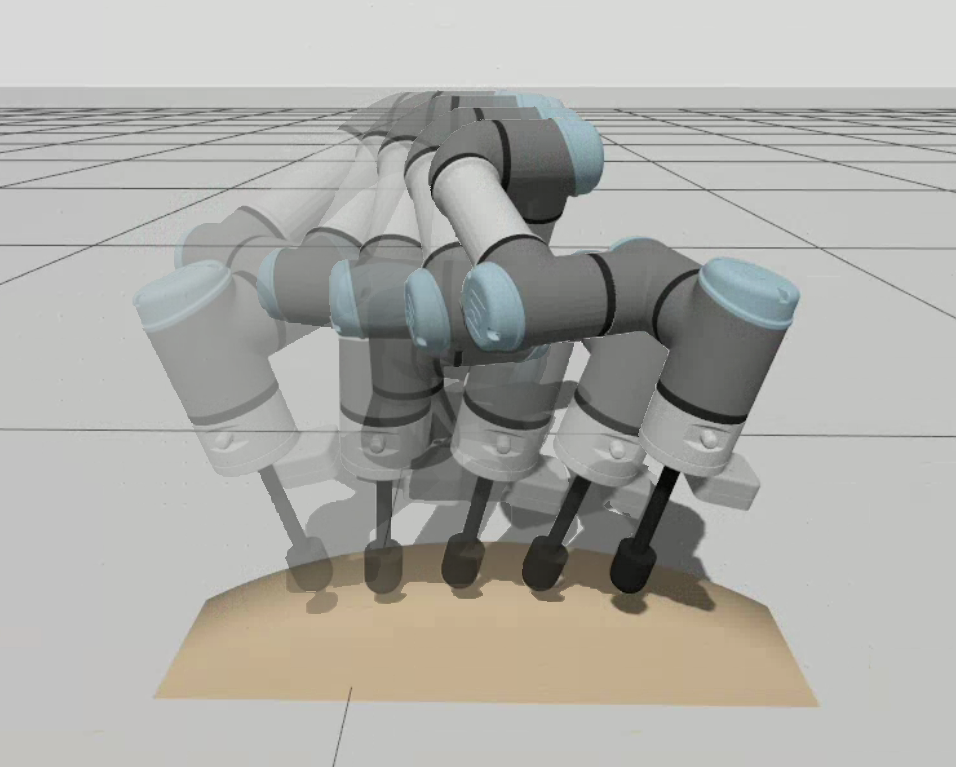
Background#
Affective touch refers to the gentle, slow stroking that happens between people, which can convey comfort, support, trust and other emotions (similar behavior has in fact been observed in primates, such as grooming). To study how humans perceive this kind of touch, researchers commonly use a soft brush as the stimulus and stroke it over the hairy skin.

Prior work1 found that the person being stroked reports the highest pleasantness when the stroking speed is 1–10 cm/s and the force is below 1 N. However, the touch-generation methods in these studies are fairly crude: they can only execute fixed trajectories and cannot control the contact force, for example. Moreover, no study has controlled the tilt angle of the brush to examine its effect on tactile perception, although we believe such an effect exists.
Research question#
Goal#
In affective-touch research, we want to know how the brush's speed \(v\), tilt angle \(\theta\) and contact force \(F\) affect perception. Since no device yet exists that can control all three variables at once, as the first step of this topic, this project develops a system that controls the three parameters simultaneously and validates it in simulation.
Main challenges#
- The geometry of the skin surface is unknown and occluded by the bristles
- The three controlled quantities have different dimensions and are coupled to each other
Approach#
- An online estimator: the core idea is to mount the depth camera ahead of the brush, so that the current contact point was already observed a short time earlier. Since the forward kinematics of the arm are known, the camera observations at each instant are transformed into the arm's base frame and buffered; the estimator then searches all historical observations in this buffer for those lying exactly on the EE axis. These observations are smoothed and upsampled with a Kalman filter
- Closed-loop control is designed at the velocity level, so the relation between the stroking speed \(v\) and the joint velocity \(\dot{q}\) becomes pure (linear) differential kinematics. The angle \(\theta\) is related to its derivative \(\dot{\theta}\) through first-order error dynamics. An auxiliary quantity \(d\) is introduced to control the normal distance from the brush to the surface, with similar first-order error dynamics relating it to \(\dot{d}\); the contact-force error \(e_F\) is converted into a distance adjustment \(\Delta d\) and handled by PID control
See the related paper for the detailed design and derivation.
-
F. McGlone, J. Wessberg, and H. Olausson, “Discriminative and Affective Touch: Sensing and Feeling,” Neuron, vol. 82, no. 4, pp. 737–755, 2014. ↩